
Davis Trendstyle
DA 620 TSC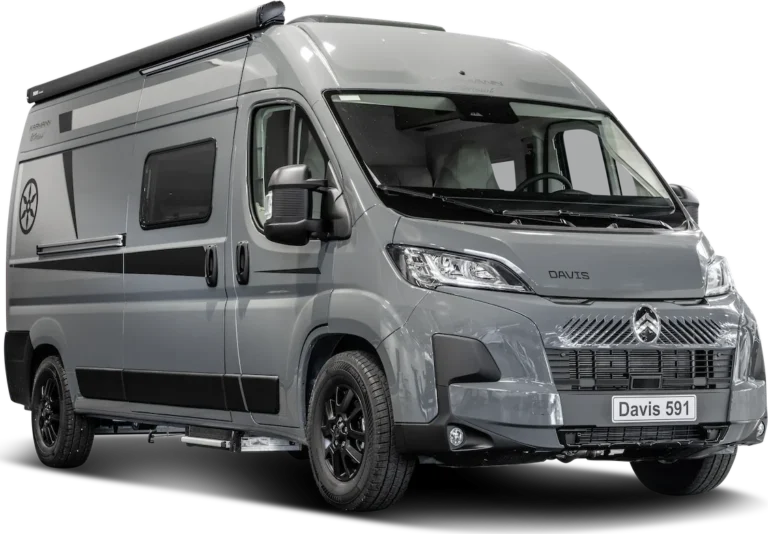

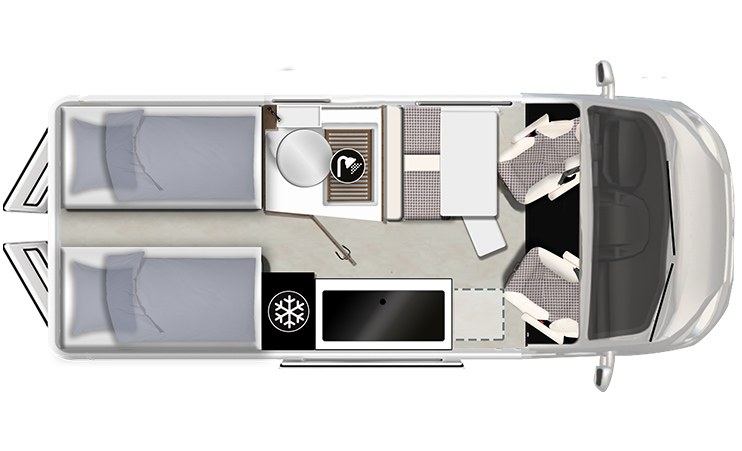
- Length6,36 m
- Sleeping places2 (3)
- Seating4
- Height2,65 m
A family campervan with removable beds at the rear, ideal for holidays for four or for transporting sports equipment.
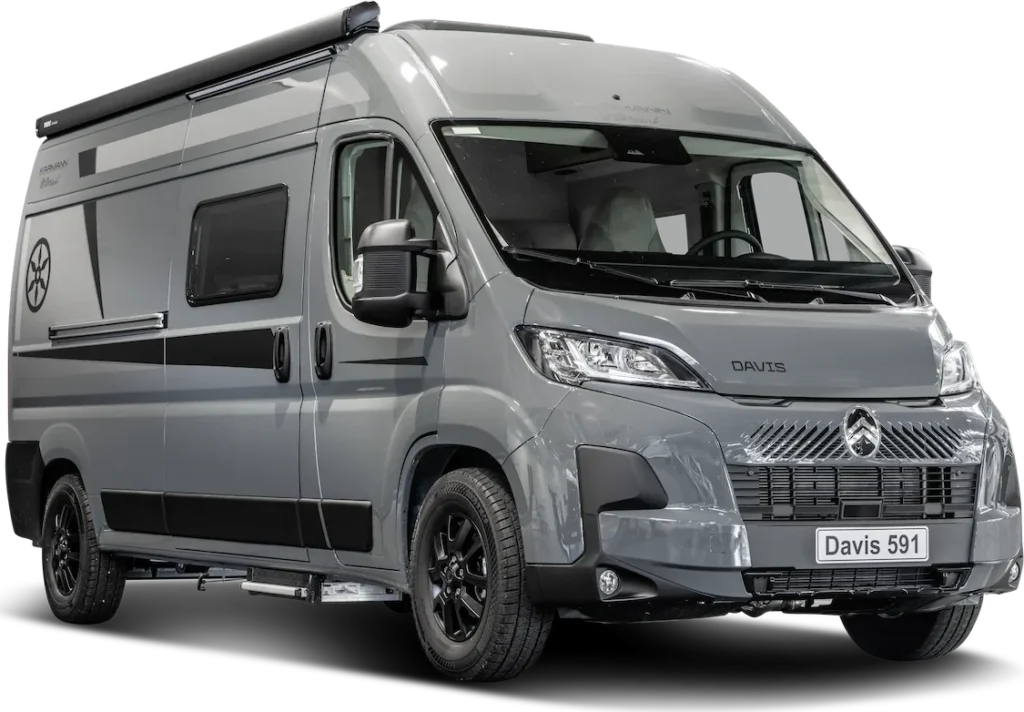 On Citroen
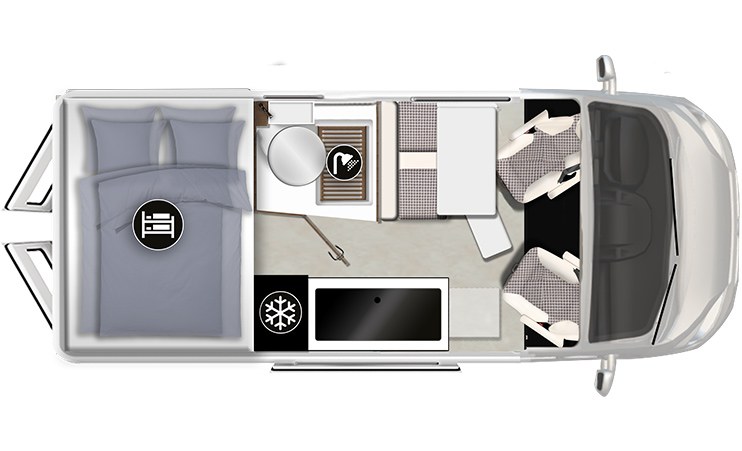
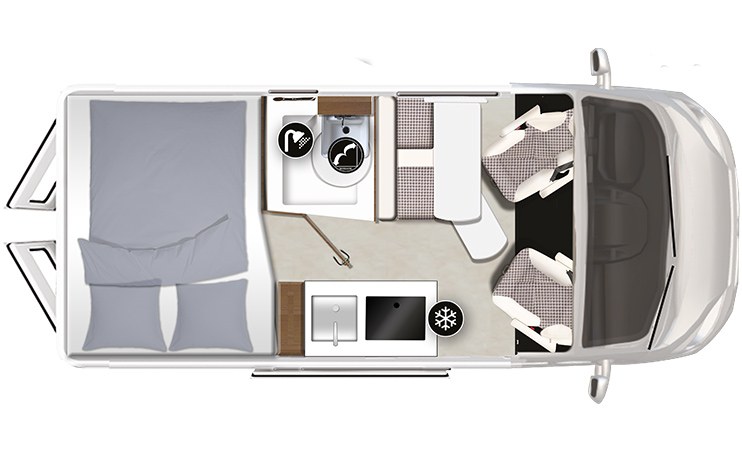
In the Davis 591 Trendstyle, you have the freedom to do exactly what you and your family want to do. This is made possible by the multifunctional rear compartment with two bunk beds, which can be removed individually or together.
Whether it’s four of you using both beds on holiday, two of you using one bed on a weekend break, or just using it as a people carrier without any beds at all to transport the whole family’s sports kit: the Davis 591 adapts to your plans.
| Basic vehicle | Citroen |
| Tyres | 225/75 R16C |
| Power (standard) | 2,2 ltr. 89kW (120 PS) |
| Power (option) | 2,2 ltr. 104 kW (140 PS) |
| Total length (mm) | 5990 |
| Total width (mm) | 2050 |
| Total height (mm) | 2650 |
| Internal width (mm) | 1860 |
| Standing height (mm) | 1890 |
| Wheel base (mm) | 4035 |
| Floor | 36 mm (inkl. Isolierung) |
| Fresh water capacity complete(5) | 90 l |
| Fresh water tank in travelling position(5) | 20 l |
| Wastewater capacity | 75 l |
| Technically permissible overall weight(1) | 3500 kg |
| Trailerload, braked | 2500 kg |
| Weight in ready-to-drive state (kg)(2) | 2844 (2702 - 2986) |
| Maximum weight for packages and optional extras (kg)(4) | 204 |
| Bed conversion seating unit | 1560x860 (500) mm |
| Rear bed | 1860x1450 - 1840x1330 mm |
| Beds | 4 |
| Extension to sleeping places | 5 |
| Permissible number of passengers with 3-pt belt(3) | 4 |
| Battery capacity | 12 V / 95 Ah |
| Gas | 2 x 5 kg |
1 The maximum mass specified by the manufacturer, which the vehicle must not exceed whilst in motion.
2 Mass including a fuel tank filled to at least 90 per cent capacity, the driver (75 kg), fresh water for the journey, gas and basic equipment. The permissible variation of ±5 per cent is shown in brackets.
3 Maximum number of seats fitted with three-point seat belts, including the driver.
4 Maximum dimensions for parcels and optional extras, to ensure compliance with the statutory minimum payload.
5 When the vehicle is in driving position, the capacity of the fresh water tank is reduced. If there is sufficient payload, it can be filled to capacity.
* Recommended retail price for Germany. Prices in other countries may vary; please contact your retailer for the price applicable to you.
You can find important information about vehicle weights here.
Take a virtual tour and have a look around at your leisure.
Choose your packages, paintwork and upholstery, and see the price straight away.
Configure now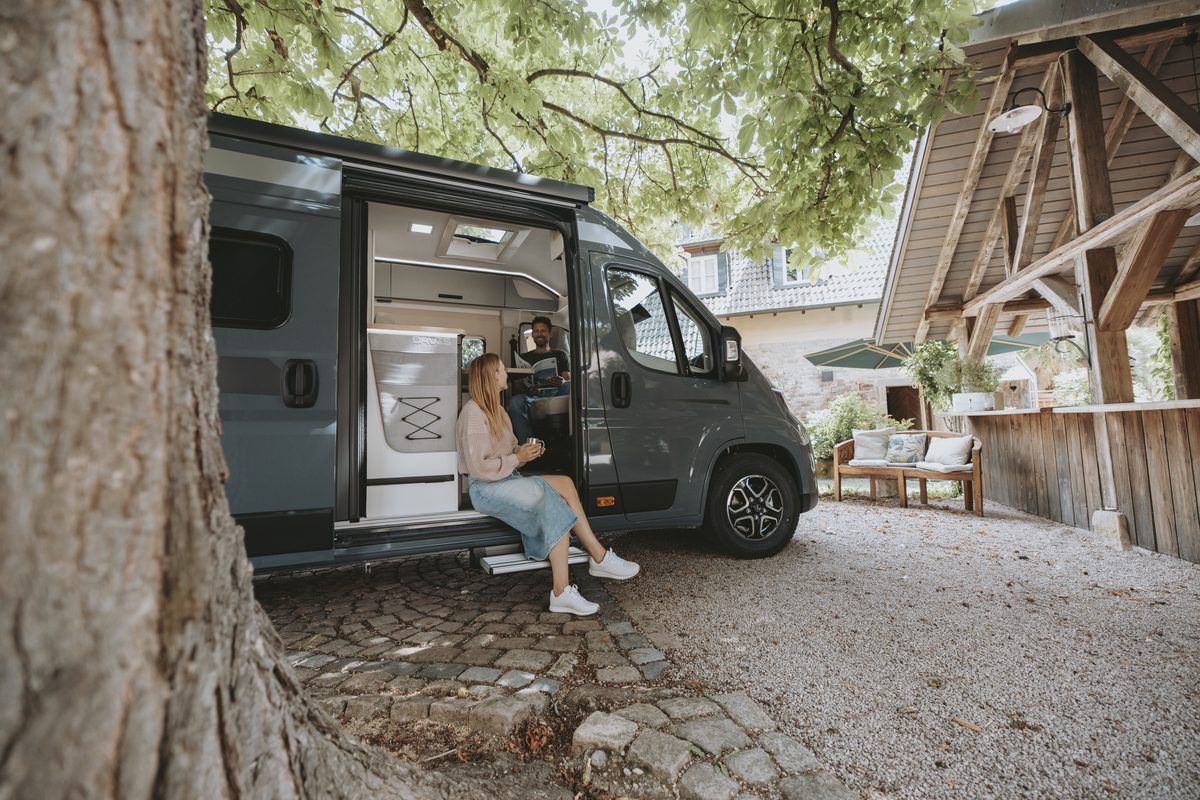
At over 80 specialist dealers, you can view and test drive your Karmann-Mobil van.
Find a retailer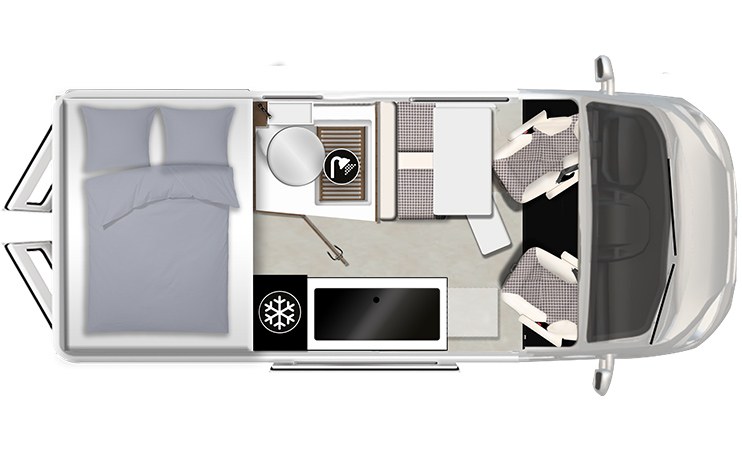
As every vehicle is only registered for a specific maximum authorised mass set by the manufacturer, weight-related specifications are particularly important when purchasing a motorhome or campervan. This applies in particular to the selection of factory-fitted packages and optional extras. The maximum authorised mass for road use must under no circumstances be exceeded whilst driving.
We have therefore provided the following information to help you configure your vehicle and to explain the legal requirements regarding vehicle weights. Please read this carefully before you begin configuring your vehicle, and contact your dealer if you have any questions.
You can find the technically permissible gross vehicle mass when fully laden in the technical specifications for our motorhomes and campervans and in the configurator. This is the gross vehicle mass specified by the manufacturer, which the vehicle must not exceed whilst on the road. Failure to do so may result in fines in many European countries, including Germany. As the driver, you are responsible for ensuring compliance with the technically permissible gross vehicle weight; we therefore recommend that you check your vehicle accordingly before every journey and weigh it before setting off.
The mass in running order refers to the mass of the vehicle with the fuel tanks filled to at least 90 per cent of their capacity, including the mass of the driver, which is assumed to be 75 kg, the fuel and other fluids, fitted with the standard equipment as specified by the manufacturer and, where applicable, the mass of the bodywork, the driver’s cab, the tow bar and the tyre repair kit. Information on the mass in running order can also be found in the technical specifications for our motorhomes and campervans, as well as in our configurator.
It is important to note that the kerb weight is a figure calculated as part of the type-approval process, which is subject to legally permissible variations of up to +/- 5 per cent. As these variations affect the remaining payload of the individual vehicle, the occurrence of legally permissible variations must be taken into account when configuring the vehicle and selecting packages and optional extras.
Example: The technical specifications state that the kerb weight for the layout you have selected is 2,910 kg. This calculated figure is subject to legally permissible variations of +/- 5 per cent, i.e. +/- 146 kg. The kerb weight of the individual vehicle may therefore range from 2,764 kg to 3,056 kg.
We also indicate the legally permissible variations in the technical specifications for our motorhomes and vans, as well as in our configurator, in brackets.
The mass of the passengers is determined by the number of seat-belt-secured seats specified by the manufacturer and is calculated at a flat rate of 75 kg per seat, from which the mass of the driver – which has already been taken into account in the mass in running order – must be deducted. For a vehicle with four seat-belt-secured seats, the mass of the passengers is therefore 225 kg (3 × 75 kg).
You can find the number of seatbelts in the technical specifications for our motorhomes and vans, as well as in our configurator. Please note that this represents the maximum number of seatbelts available for the respective layout as standard. However, the number of seatbelts may be reduced depending on the selection of packages and optional extras, or may require the vehicle to be re-rated.
The actual mass of the vehicle refers to the mass of the vehicle in running order, plus any packages or optional extras fitted at the factory, and is entered under section 13.2 of the Certificate of Conformity (CoC). This does not include optional extras or other accessories that are fitted after the vehicle has been delivered ex-works, either by a dealer or by you personally.
Please note that the actual mass of the vehicle is also a calculated value which, due to legally permissible variations in mass when the vehicle is in running order, may differ from the value determined for your specific vehicle as a basis for calculating the actual vehicle mass. Details of the weights of the packages and optional extras offered ex-works for our motorhomes and vans can be found in our configurator.
The payload refers to the maximum load that a vehicle can carry, and is calculated by subtracting the kerb weight, the mass of the passengers and the mass of the factory-fitted packages and optional extras from the technically permissible gross vehicle mass.
Example:
| Technically permissible maximum mass | 3,500 kg |
| Weight when ready to drive | – 2,910 kg |
| Total weight of passengers (3 × 75 kg) | – 225 kg |
| Dimensions of the packages / optional extras | – 100 kg |
| Payload | = 265 kg |
The installation of packages and optional extras therefore always results in a reduction in payload. The maximum weight available for packages and optional extras for each specific layout is shown separately in the technical specifications for our motorhomes and campervans and in our configurator.
For motorhomes and vans classified as M1 vehicles, compliance with a minimum payload – that is, the minimum load a vehicle can carry – is required by law. This minimum payload must not be undercut either during the configuration of a vehicle or during production, and is calculated for our motorhomes and vans using the following formula:
Minimum payload in kg ≥ 10 * (n + L)
The following applies: „n“ is the maximum number of seatbeltequipped seats plus the driver, and „L“ is the total length of the vehicle in metres.
Example: For a motorhome with 4 seatbelts and a length of 7 m, the minimum payload is 110 kg (10 * [4 + 7]).
It is important to note that legally permissible variations in the mass in running order can increase, but also reduce, the payload of an individual vehicle.
Example (as before):
| Technically permissible maximum mass | 3,500 kg |
| Mass in running order (+ 4 %) | – 3,026.4 kg |
| Total weight of passengers (3 × 75 kg) | – 225 kg |
| Dimensions of the packages / optional extras | – 100 kg |
| Payload | = 148.6 kg |
To prevent such fluctuations from causing the payload to fall below the statutory minimum, we have set a maximum weight limit for luggage and optional extras, based on actual historical fluctuations observed by the manufacturer. You can find details on this in the technical specifications for our motorhomes and campervans, as well as in our configurator. This also takes into account specific equipment features of country-specific variants and special models that are not part of the standard specification.
If, whilst configuring our motorhomes and vans by selecting packages and optional extras, you exceed the upper limit set by the manufacturer for this purpose, you can only continue with the configuration if you deselect packages, optional extras or seatbelts, or if you choose to increase the vehicle’s load capacity. Otherwise, it will not be possible to continue with the configuration or to order the configured vehicle.
In exceptional cases, weighing at the end of the loading process may – despite the weight limits for parcels and optional extras – result in the individual vehicle’s payload falling below the minimum permissible level due to legally permitted variations. In such a case, we will not deliver the vehicle in question until compliance with the minimum payload has been ensured by removing parcels, optional extras or seatbelts, or by increasing the vehicle’s load.